









Zimbabwe's internet service providers are generating higher revenues from a rapidly expanding digital market, but new industry figures show they are simultaneously cutting investment in network infrastructure, raising questions about whether the country's digital transformation can be sustained without stronger capital spending.
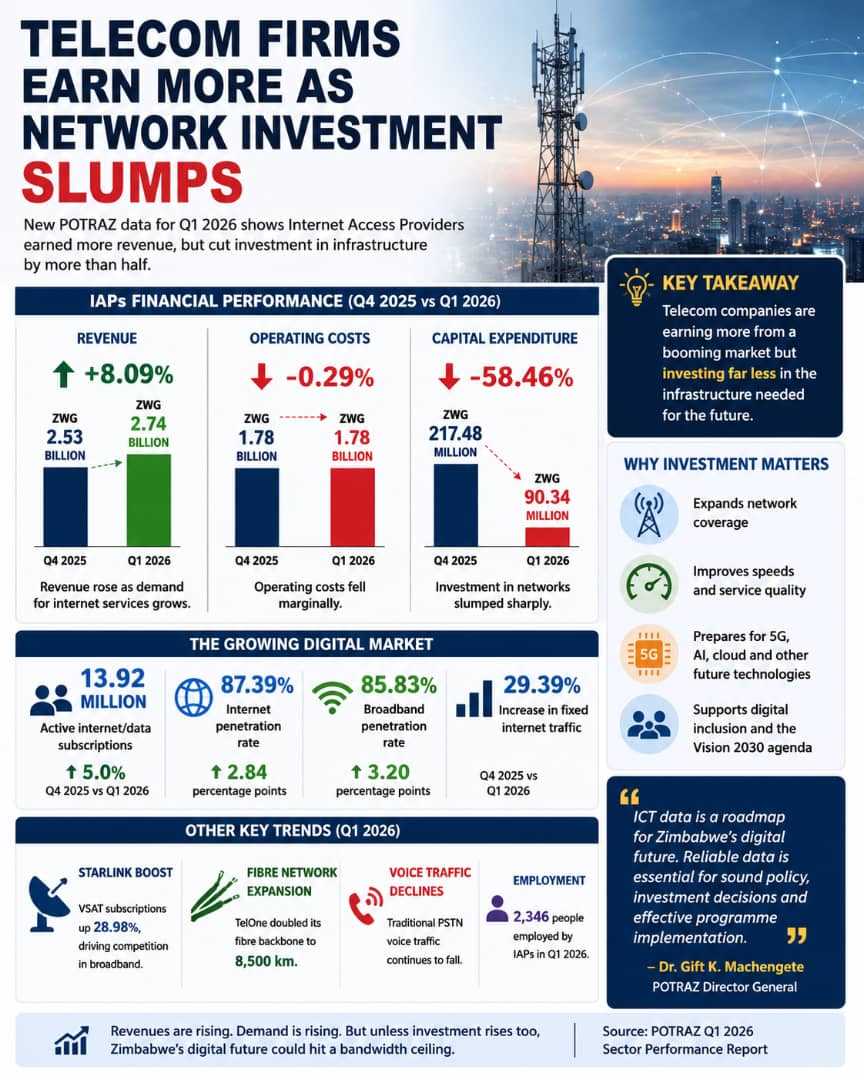
New data from the Postal and Telecommunications Regulatory Authority of Zimbabwe shows that Internet Access Providers increased revenue by 8.09 percent during the first quarter of 2026, from ZWG2.53 billion to ZWG2.74 billion. However, capital expenditure plunged by 58.46 percent, from ZWG217.48 million to ZWG90.34 million over the same period, while operating costs fell marginally by 0.29 percent.
The figures come as Zimbabwe experiences record demand for internet services. Active internet and data subscriptions rose five percent to 13.92 million, pushing internet penetration to 87.39 percent, while broadband penetration climbed to 85.83 percent, reflecting growing reliance on digital connectivity across households and businesses.
The contradiction between rising revenues and sharply lower investment is emerging as one of the most significant findings in the telecommunications sector. While operators are benefiting from increased demand for data services, the slowdown in capital spending could affect future network expansion, service quality and the country's ability to support increasingly data-intensive technologies.
POTRAZ Director-General Gift Machengete has previously described ICT data as "a roadmap for Zimbabwe's digital future," saying reliable statistics are essential for sound policy, investment decisions and programme implementation. He urged stakeholders to use the findings to strengthen digital inclusion, enhance digital skills and accelerate digital transformation.
The latest sector report suggests operators may be adopting a more cautious investment strategy despite improving financial performance.
Related Stories
The report also shows fixed internet traffic increased by 29.39 percent during the quarter, driven by growing demand for broadband services. Liquid Intelligent Technologies recorded a 47.58 percent increase in internet traffic, while Starlink continued expanding its footprint, contributing to a 28.98 percent rise in VSAT subscriptions.
Meanwhile, competition within the sector is intensifying. TelOne more than doubled its national fibre backbone from 4,046 kilometres to 8,500 kilometres, helping expand Zimbabwe's total fibre network by 33.83 percent to over 19,200 kilometres.
Despite these infrastructure gains, analysts say sustained investment remains critical as Zimbabwe moves towards a digital economy.
Telecommunications networks require continuous capital expenditure to expand coverage, upgrade equipment, improve speeds and prepare for emerging technologies such as artificial intelligence applications, cloud computing and wider 5G deployment.
The decline in capital spending also comes at a time when Zimbabwe's digital ambitions are accelerating. The recently released 2025 ICT Access by Households and Use by Individuals Survey found that 75.5 percent of households now have internet access, while 31 percent of internet users are already using artificial intelligence tools, signalling growing demand for more sophisticated digital infrastructure.
POTRAZ itself expects internet traffic to continue rising. In its sector outlook, the regulator said competition from satellite broadband and fibre operators is expected to drive market efficiency and competitive pricing, while operators are anticipated to accelerate deployment of LTE, 5G base stations and fibre infrastructure to narrow the digital divide.








Leave Comments